Sunday, March 29, 2015

Spread your wings

From the fastest to the biggest, this time the bird we’re dealing with is the magnificent Andean Condor (Vultur gryphus). With a total wingspan reaching up to just over 3m they narrowly beat their North American counterpart; the critically endangered California condor (Gymnogyps californianus) in being the biggest bird of prey in terms of wingspan (Ferguson-Lees and Christie, 2001). Condors are part of the family of Cathartidae or more commonly known as New World Vultures, these guys are all scavengers and was once thought to be cousins of old world vultures but was realised later with genetic testing that New world vultures and old world vultures’ similarity was due to convergence in occupying similar niches (Wink, 1995).
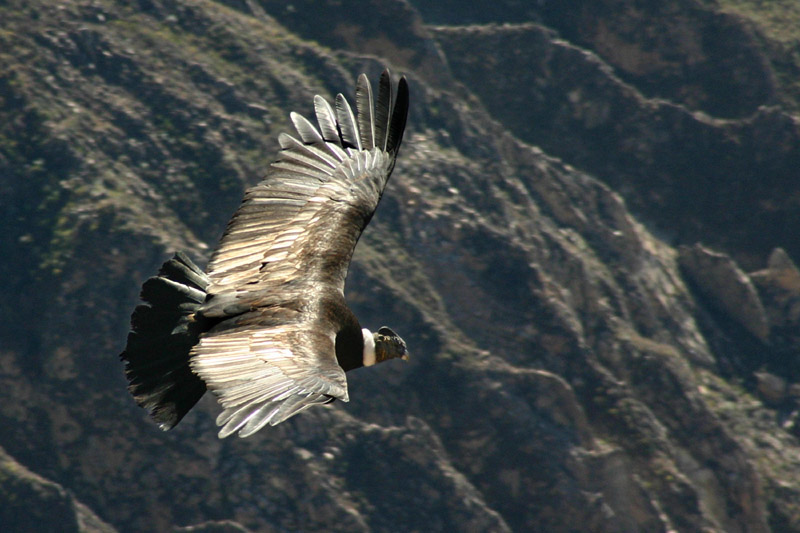
File:Condor flying over the Colca canyon in Peru.jpg
Vultur Gryphus soaring over the Colca Canyon in Peru  (Abehm-de, 2005).
Back to V.gryphus!!! These guys are big, really big, so how do they keep themselves in the air? Well, that’s where their huge wings come in handy, V.gryphus’ flight ability relies greatly on the updraught of air usually near cliff walls and canyons (McGahan, 1973). The large wingspan and high surface area of their wings allow for the updraught to generate most of the lift they need to stay in the air. V.gryphus like previously mentioned are scavengers, therefore they primarily feed on carrion. Which is why Andean condors prefer to scour the open grasslands by gliding high in the air transect sailing over the area or by random soaring above open areas (Ferguson-Lees and Christie, 2001). Because of their predominantly gliding style of flight they are able to travel far and scan a large areas for resources while minimising energy use, with estimates of covering up to 50km just by gliding (McGahan, 1973, Shepard et al., 2011, Duriez et al., 2014).

Once thought of as predators due to the size and tendency to feed on dead livestock, V.gryphus had been on the receiving end of human prejudice and was hunted and poisoned ever since European settlement in the region. Luckily that is no longer the case and there are many places they roam free once again, soaring high above the Andes (Ferguson-Lees and Christie, 2001).


ABEHM-DE 2005. Condor flying over the Colca canyon in Peru. http://commons.wikimedia.org/wiki/File:Condor_flying_over_the_Colca_canyon_in_Peru.jpg; retrieved 29/03/2015
DURIEZ, O., KATO, A., TROMP, C., DELL'OMO, G., VYSSOTSKI, A. L., SARRAZIN, F. & ROPERT-COUDERT, Y. 2014. How Cheap Is Soaring Flight in Raptors? A Preliminary Investigation in Freely-Flying Vultures. PLoS ONE, 9, e84887.
FERGUSON-LEES, J. & CHRISTIE, D. A. 2001. Raptors of the world, Houghton Mifflin Harcourt.
MCGAHAN, J. 1973. Gliding Flight of the Andean Condor in Nature. Journal of Experimental Biology, 58, 225-237.
SHEPARD, E. L. C., LAMBERTUCCI, S. A., VALLMITJANA, D. & WILSON, R. P. 2011. Energy Beyond Food: Foraging Theory Informs Time Spent in Thermals by a Large Soaring Bird. PLoS ONE, 6, e27375.
WINK, M. 1995. Phylogeny of Old and New World vultures (Aves: Accipitridae and Cathartidae) inferred from nucleotide sequences of the mitochondrial cytochrome b gene. Zeitschrift für Naturforschung.C, Journal of biosciences, 50, 868.

Sunday, March 22, 2015

I feel the need...the need for speed!


Ahhh the speedster of which I’m talking about our good friend, Falco peregrinus better known to most people as the peregrine falcon. They are the fastest travelling animal in the world (things like mantis shrimp’s punches don’t count here), the official record speed being 389km/hour and higher estimates of up to 440kms/hour(Ferguson-Lees and Christie, 2001, National Geographic (2007)! They have been a part of human history for thousands of years and now resides in many urban cities. One of the most geographically widespread bird of prey in the world, F.peregrinus populations in different regions vary quite a bit in their migration patterns. Tropical and lower-altitude populations are mostly sedentary while some more temperate populations can migrate medium to very long distances (Ferguson-Lees and Christie, 2001). Their geographically wide distribution led to more than 25 subspecies/races being classified around the world (Ferguson-Lees and Christie, 2001, Bell et al., 2014).
Fig.1 Distribution map of F. peregrinus darker shades indicate higher density (Ferguson-Lees and Christie, 2001).


Fig.2 Stages of dive of F.peregrinus(Ferguson-Lees and Christie, 2001)
F.peregrinus’ diet almost consists entirely of birds, hunting by either an aerial chase or more famously by diving onto its prey in a number of different strategies (Zoratto et al., 2010, National Geographic, 2013). Their prey choice can be quite different depending on the habitat they live in, they’re known to hunt up to 1000+ species of birds worldwide including other raptors and some birds 2-3 times their weight, there’s also the occasional cannibalism as well as rabbits, hares, reptiles and amphibians (Ferguson-Lees and Christie, 2001). These guys may sound successful enough but were once heavily affected by pesticides like DDT which ravaged their populations to the point of being listed as endangered by weakening the shell of eggs (Ratcliffe, 1967, Hickey and Anderson, 1968, Smith et al., 2015). But conservation efforts and the ban of DDT have proved fruitful and allowed peregrine populations to recover and they can now again be found in many places, even bustling cities like New York City (NYC Environmental Protection, 2015).

So next time you head out, try and look up towards the cliffs and skyscrapers and maybe catch a glimpse of these speedsters

BELL, D. A., GRIFFITHS, C. S., CABALLERO, I. C., HARTLEY, R. R. & LAWSON, R. H. 2014. Genetic Evidence for Global Dispersal in the Peregrine Falcon (Falco peregrinus) and Affinity with the Taita Falcon (Falco fasciinucha). Journal of Raptor Research, 48, 44-53.
FERGUSON-LEES, J. & CHRISTIE, D. A. 2001. Raptors of the world, Houghton Mifflin Harcourt.
NATIONAL GEOGRAPHIC. 2007. High-Velocity Falcons. National Geographic.
NATIONAL GEOGRAPHIC. 2013. World's Deadliest: Superfast Flyer Makes a Kill.
HICKEY, J. J. & ANDERSON, D. W. 1968. Chlorinated Hydrocarbons and Eggshell Changes in Raptorial and Fish-Eating Birds. Science, 162, 271-273.
PROTECTION, N. E. 2015. Peregrine Falcons in New York City [Online]. New York City: NYC Environmental Protection. Available: http://www.nyc.gov/html/dep/html/news/falcon.shtml.
RATCLIFFE, D. A. 1967. Decrease in Eggshell Weight in Certain Birds of Prey. Nature, 215, 208-210.
SMITH, G., MURILLO-GARCÍA, O., HOSTETLER, J., MEARNS, R., ROLLIE, C., NEWTON, I., MCGRADY, M. & OLI, M. 2015. Demography of population recovery: survival and fidelity of peregrine falcons at various stages of population recovery. Oecologia, 1-11.
ZORATTO, F., CARERE, C., CHIAROTTI, F., SANTUCCI, D. & ALLEVA, E. 2010. Aerial hunting behaviour and predation success by peregrine falcons Falco peregrinus on starling flocks Sturnus vulgaris. Journal of Avian Biology, 41, 427-433.

Thursday, March 12, 2015

Birds of What?


Hi there, welcome to Beak and Talon, where I'll be talking about morphological (physical attributes like beaks, wings and crests) and some behavioural adaptations of Birds of Prey, Raptors or whichever is to your liking. Maybe you’re wondering, what is a bird of prey or raptor? Like those things in Jurassic park? Or do you just have no clue? Well for those of you who fit in the latter category, I think this is a good place to start.


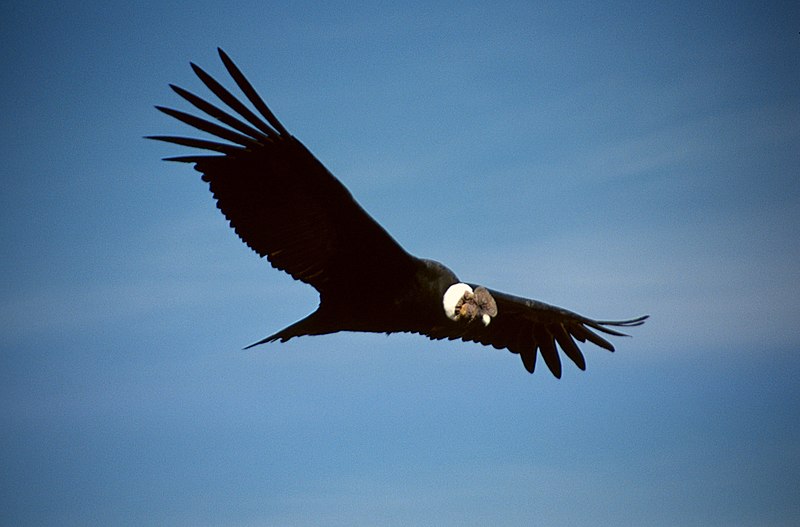
Birds of prey is a broad term referring to a variety of families of birds which are carnivorous in nature. There are both diurnal and nocturnal species e.g. falcons and owls. Owls have been around at least since the Paleocene more than 56mya (Mayr, 2006) and other taxa (scientific term regarding a taxonomical group ie. What scientists use to classify different living things) such as the family Accipitridae (Hawks, eagles, old world vultures etc.) have been around for at least 20 million years (Walker and Dyke, 2006). They usually have sharp hooked beaks, sharp talons and generally have very good eyesight because of their similar roles in their ecosystems. They vary greatly in size from the small black-thighed falconet with a wingspan of only about 30cm (about the size of a sparrow to the massive Andean condor which can have wingspans of just over 3m (Ferguson-Lees and Christie, 2001).
File:Colca-condor-c03.jpg
Adult Andean Condor in flight.     Source: www.wikipedia.org
These remarkable group of birds can be found all over the world from the deserts of Africa and Australia to the rainforests in South East Asia and even the Arctic Circle (Ferguson-Lees and Christie, 2001)Each group of birds has their own specialty and have procured different evolutionary tactics when they hunt or forage for food. Despite the differences between species, there are general similarities for different families, from the scavenging vultures and condors to the striking falcons and vice gripping eagles. These birds have all evolved to fulfill their specific niche; from gliding to diving, tearing and gripping, ripping and striking, their wings, talons and beaks are all suited to their needs and behaviours and that’s just skimming the surface of what these wonderful creatures have to offer.

Come back next week as we start to look at each of these birds more closely!


FERGUSON-LEES, J. & CHRISTIE, D. A. 2001. Raptors of the world, Houghton Mifflin Harcourt.
MAYR, G. 2006. A new raptorial bird from the Middle Eocene of Messel, Germany. Historical Biology, 18, 99-102.
WALKER, C. A. & DYKE, G. J. 2006. New records of fossil birds of prey from the Miocene of Kenya. Historical Biology, 18, 95-98.