From the fastest to the biggest, this time the bird we’re
dealing with is the magnificent Andean Condor (Vultur gryphus). With a total wingspan reaching up to just over 3m they
narrowly beat their North American counterpart; the critically endangered
California condor (Gymnogyps californianus) in being the
biggest bird of prey in terms of wingspan (Ferguson-Lees and Christie, 2001). Condors are part of the
family of Cathartidae or more
commonly known as New World Vultures, these guys are all scavengers and was
once thought to be cousins of old world vultures but was realised later with
genetic testing that New world vultures and old world vultures’ similarity was
due to convergence in occupying similar niches (Wink, 1995).
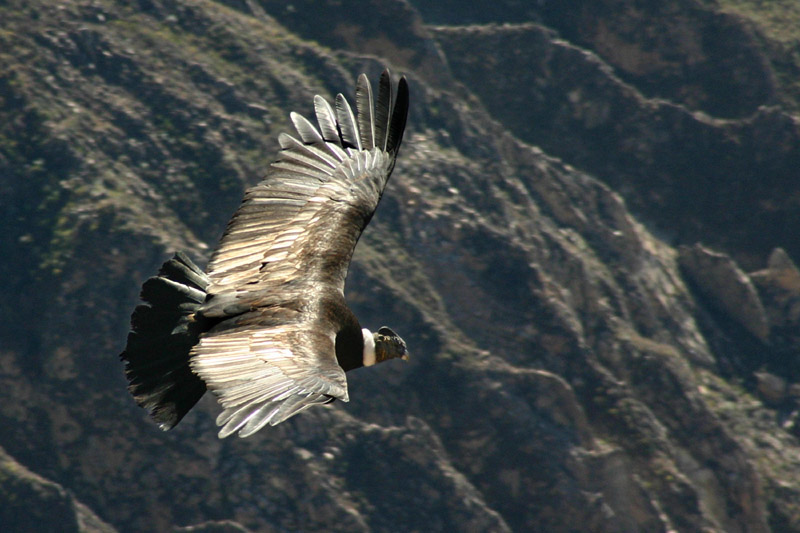 |
| Vultur Gryphus soaring over the Colca Canyon in Peru (Abehm-de, 2005). |
Back to V.gryphus!!!
These guys are big, really big, so how do they keep themselves in the air?
Well, that’s where their huge wings come in handy, V.gryphus’ flight ability relies greatly on the updraught of air usually
near cliff walls and canyons (McGahan, 1973). The large wingspan and high surface area of
their wings allow for the updraught to generate most of the lift they need to
stay in the air. V.gryphus like
previously mentioned are scavengers, therefore they primarily feed on carrion. Which
is why Andean condors prefer to scour the open grasslands by gliding high in
the air transect sailing over the area or by random soaring above open areas (Ferguson-Lees and Christie, 2001). Because of their
predominantly gliding style of flight they are able to travel far and scan a
large areas for resources while minimising energy use, with estimates of
covering up to 50km just by gliding (McGahan, 1973, Shepard et al., 2011, Duriez et al., 2014).
Once thought of as predators due to the size and tendency to
feed on dead livestock, V.gryphus had
been on the receiving end of human prejudice and was hunted and poisoned ever
since European settlement in the region. Luckily that is no longer the case and
there are many places they roam free once again, soaring high above the Andes (Ferguson-Lees and Christie, 2001).
ABEHM-DE 2005. Condor flying over the Colca canyon in Peru. http://commons.wikimedia.org/wiki/File:Condor_flying_over_the_Colca_canyon_in_Peru.jpg; retrieved 29/03/2015
DURIEZ, O., KATO, A., TROMP, C., DELL'OMO,
G., VYSSOTSKI, A. L., SARRAZIN, F. & ROPERT-COUDERT, Y. 2014. How Cheap Is
Soaring Flight in Raptors? A Preliminary Investigation in Freely-Flying
Vultures. PLoS ONE, 9, e84887.
FERGUSON-LEES,
J. & CHRISTIE, D. A. 2001. Raptors of
the world, Houghton Mifflin Harcourt.
MCGAHAN, J.
1973. Gliding Flight of the Andean Condor in Nature. Journal of Experimental Biology, 58, 225-237.
SHEPARD, E.
L. C., LAMBERTUCCI, S. A., VALLMITJANA, D. & WILSON, R. P. 2011. Energy
Beyond Food: Foraging Theory Informs Time Spent in Thermals by a Large Soaring
Bird. PLoS ONE, 6, e27375.
WINK,
M. 1995. Phylogeny of Old and New World vultures (Aves: Accipitridae and
Cathartidae) inferred from nucleotide sequences of the mitochondrial cytochrome
b gene. Zeitschrift für Naturforschung.C,
Journal of biosciences, 50, 868.
You mention that these birds utilise updrafts to facilitate flight. From an energetic cost, this sounds like a great plan if you have a big body. But, these guys are scavengers and dead meat doesn’t usually fly, so how do they initiate lift off, being so heavy? Surely that must be a really huge energetic cost!? Also, is there any research on why they have evolved to be so big? Interesting bird!
ReplyDeleteThey usually stay near high cliff edges where the updraughts are just over the edge, to minimise the amount of energy they use to take off, their wings are powerful enough to fly off the ground, but when they're searching for prey, it's more efficient to use the updraughts and glide. I personally haven't found much research on the energy use on takeoff, but there has been studies done regarding them gliding vs active flying and the efficiency of the two methods., I have no idea why they're so big, my best guess would be, maybe their size help with temperature regulation as they are solitary animals and tend to live in the colder regions of the Andes. Will have to look it up haha
ReplyDelete