 |
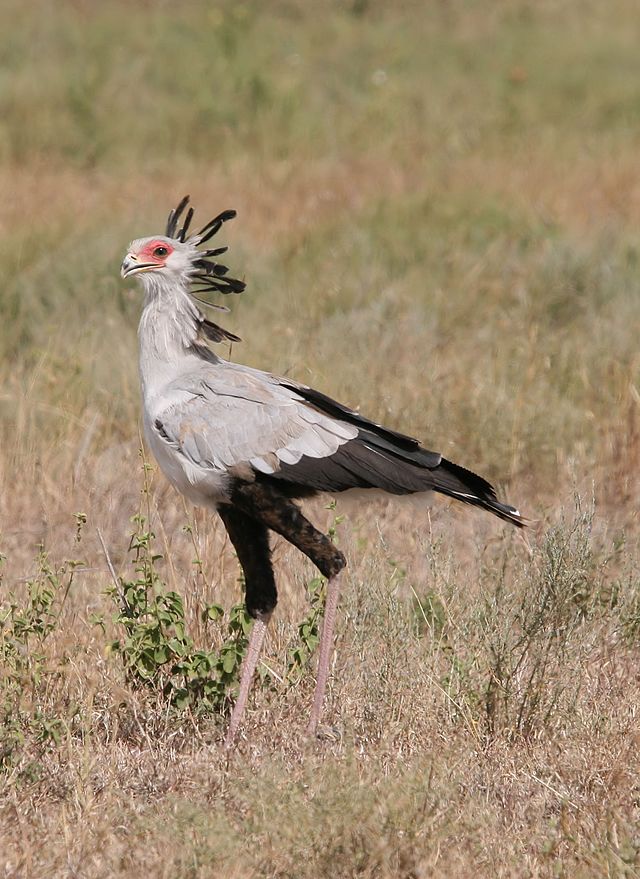
| Sagittarius serpentarius: taken at Serengeti National Park, Tanzania. (User:Yoki, 2008) |
All birds of prey fly, with no exception. However there is
one bird who walks and stomps the grasslands of Africa, the secretarybird (Sagittarius serpentarius) – The snake
archer (just a damn cool name). Unlike other birds of prey, S.serpentarius likes to spend most of its
time on the ground, preferring to walk rather than run and run rather than fly (Ferguson-Lees and Christie, 2001). Although more terrestrial in
nature, S.serpentarius builds their
nests in low trees and are monogamous (having a single mate for life) (Ferguson-Lees and Christie, 2001, Hofmeyr et al., 2014).
The secretarybird occupies quite a large range, covering
much of sub-Saharan Africa, when they aren’t breeding they tend to be nomadic and
are relatively rare to spot. Aside from being nomadic and monogamous, they are
also territorial and roosts and builds nests on trees in their territory (Kemp, 1995, Hofmeyr et al., 2014).
S.serpentarius shows some interesting
behaviours, in flight they they may perform dives at each other, showing their
claws at each other; sky dances, which is characteristic of accipitriforme
eagles and hawks. Meanwhile, on the ground they chase each other around with
wings raised much like cranes and storks (Ferguson-Lees and Christie, 2001).
The last two points should give you a hint to where I’m
going with this, yes phylogeny!!! Being part of a monotypic family and genus:
Sagittariidae and Sagittarius (that
is, there’s only one genus in the family and only one species in the genus), they
are considered quite unique. But just how unique are they in terms of phylogeny?
Well it turns out there’s still a lot of debate regarding where secretarybirds
lie in terms of phylogeny, although it is accepted with genetic testing that
they are closer to eagles and hawks (Accipitridae) and ospreys (Pandioniae)
than to falcons and storks and cranes, putting them under the order of Accipitriformes
(Mahmood et al., 2014).
 |
| Fig. 1 Phylogram of families retrieved by matching genes, species marked with star used genome which are reported in the study which this is taken from. Values for bootstrap and pp values are shown at the nodes, * equaling to 100% bootstrap and 1.0 pp value, - equaling less than 60% bootstrap and lower than 0.9 pp value. Nodes where bootstrap and pp are both less than 60% are not shown (Mahmood et al., 2014). |
 |
| Sagittarius serpentarius flying overhead at Tsavo East National Park, Kenya. (User: putneymark, 2007) |
S.serpertarius are
listed as vulnerable and have seen a decline in population in recent years,
owing to a number of threats including habitat encroachment, afforestation,
disturbance of breeding, grazing of livestock removing habitat and being
captured or killed by humans (Birdlife International, 2013, Ferguson-Lees and Christie, 2001, Hofmeyr et al., 2014).
If we are to keep this archer of snakes around we must plan our developments
and stop the habitat degradation and encroachment or it looks like their
population will continue to decline.
FERGUSON-LEES, J. & CHRISTIE, D. A.
2001. Raptors of the world, Houghton Mifflin
Harcourt.
HOFMEYR, S.
D., SYMES, C. T. & UNDERHILL, L. G. 2014. Secretarybird Sagittarius
serpentarius Population Trends and Ecology: Insights from South African Citizen
Science Data. PLoS One, 9.
KEMP, A. C.
1995. ASPECTS OF THE BREEDING BIOLOGY AND BEHAVIOUR OF THE SECRETARYBIRD
SAGITTARIUS SERPENTARIUS NEAR PRETORIA, SOUTH AFRICA. Ostrich, 66, 61-68.
MAHMOOD,
M. T., MCLENACHAN, P. A., GIBB, G. C. & PENNY, D. 2014. Phylogenetic
position of avian nocturnal and diurnal raptors. Genome biology and evolution, 6,
326-332.
USER: PUTNEYMARK 2007. secretary bird Tsavo East feb 2007. Available: http://en.wikipedia.org/wiki/Secretarybird#/media/File:Sagittarius_serpentarius_-Tsavo_East_National_Park,_Kenya_-flying-8.jpg; Retrieved 05/04/2015
USER: YOKI 2008. Secretary Bird (Sagittarius serpentarius). Available: http://en.wikipedia.org/wiki/Secretarybird#/media/File:Sagittarius_serpentarius_Sekret%C3%A4r.JPG; Retrieved 05/04/2015

Secretary birds are beautiful, but elusive birds! Yes, the Latin name is much more exciting that the common name! Do you know why they are called secretary birds? Are they also unique in their hunting methods, compared to other birds of prey? I know they seem to think snakes are a delicacy. Thanks for posting on one of my favourite bird species!
ReplyDeletewell according to Ferguson-Lees and Christie, the name is derived from arabic saqr-et-tair linking "hunter/hawk" with "flight" (though it was originally thought to be derived from the crest which resemble quill-pens behind the ears like old time secretaries. I think their hunting method of stamping on their prey is pretty unique, i don't think there are any other birds of prey that does the same but I'll need to check that.
ReplyDelete