This week I’m going to talk about one of two species of
diurnal raptor which occurs on all 6 habitable continents (Antarctica being
inhabitable to raptors). The other of course being Falco peregrinus (peregrine falcon) which I’ve covered on my second
post, this time it is about a bird of prey commonly known as the osprey or fish
eagle/hawk. Ospreys (Pandion haliaetus)
is a monotypic species of raptor which feeds almost entirely on fish, both
freshwater and salt water species usually between 100-300g (Ferguson-Lees and Christie, 2001). Although their range is
large, the breeding range is almost entirely Holarctic and Australasian, and
most populations are migratory (Ferguson-Lees and Christie, 2001).
 |
| Figure 1. Map of global distribution of Pandion haliaetus. Darker shades indicate areas which breeding occurs, resident or at least regular occurance throughout the year. Light shade indicate regular presence but does not breed. (Ferguson-Lees and Christie, 2001) |
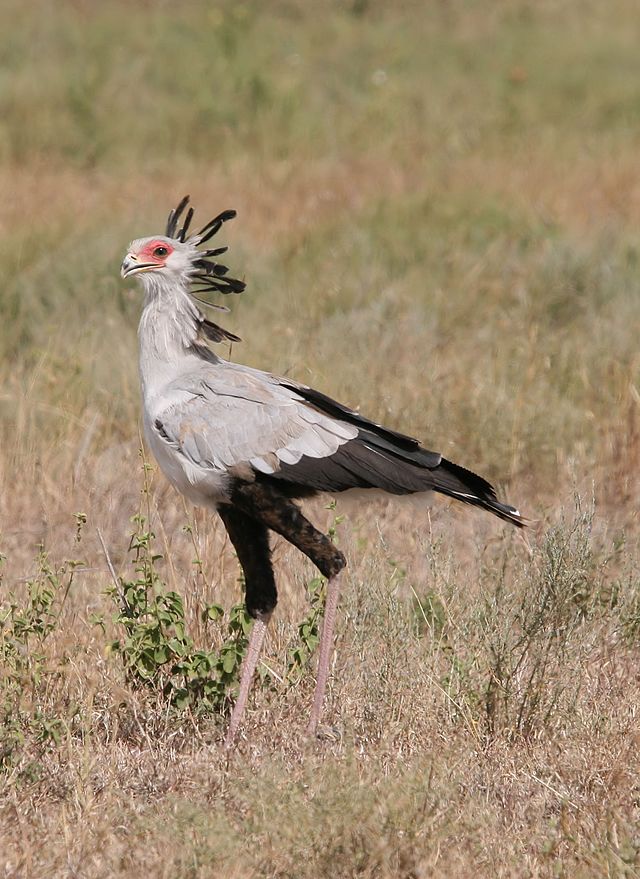
Genetically Pandionidae forms a clade with Sagittaridae (secretarybirds),
and Accipitridae (hawks, eagles, old world vultures, kites etc.), Pandionidae
being closer related to Accipitridae than to Sagittaridae (Nishida et al., 2014). However this being said, the
karyotypes of the different families are very different, Nishida et al. (2014) suggests that 2 major episode of chromosome
rearrangement occurred within the clade; fission of macrochromosomes occurred frequently
in ancestral forms and a high frequency of microchromosomal fusions in the
lineage of Pandionidae and Accipitridae.
 |
Pandion haliaetus with prey fish, at Morro Strand State Beach near Azure Street, Morro Bay, CA (Baird, 2006)
|
Since I live in Australia, let’s have a closer look at the
Australasian Ospreys (P.h.cristatus),
this subspecies of osprey is distributed from Indonesia down to Tasmania along
the coast (Dennis and Clancy, 2014, Ferguson-Lees and Christie, 2001). The main morphological
difference between P.h.crisatus and
its Northern Hemisphere counterparts is that they are generally 12 – 14%
smaller for both sexes (Dennis and Clancy, 2014, Ferguson-Lees and Christie, 2001). The highest population
density of P.h.cristatus is in the
tropical coastline of Australia, mainly Northern Territory and Western
Australia. Incidentally the abundance of osprey lowers where urban development
and tourism infrastructures are more extensive (Dennis and Clancy, 2014).
 |
| P.h.cristatus feeding on perch at Coral Bay, Western Australia
(User: Psylexic, 2007)
|
“I think he'll be to Rome As is the osprey to the fish, who
takes it By sovereignty of nature.” (Shakespeare, 2010).
On that note, I think that’s enough for today’s post.
COCKER, M. &
MABEY, R. 2005. Birds britannica,
Random House.
DENNIS, T. E. & CLANCY, G. P. 2014. The Status of the Osprey
(Pandion haliaetus cristatus) in Australia. Journal
of Raptor Research, 48, 408-414.
FERGUSON-LEES, J. & CHRISTIE, D. A. 2001. Raptors of the world, Houghton Mifflin Harcourt.
NISHIDA, C., ISHISHITA, S., YAMADA, K., GRIFFIN, D. K. & MATSUDA,
Y. 2014. Dynamic Chromosome Reorganization in the Osprey (Pandion haliaetus,
Pandionidae, Falconiformes): Relationship between Chromosome Size and the
Chromosomal Distribution of Centromeric Repetitive DNA Sequences. Cytogenetic and Genome Research, 142, 179-189.
SHAKESPEARE, W. 2010. Coriolanus,
Cambridge University Press.
USER: PSYLEXIC 2007. Pandion cristatus. Wikipedia.