Saturday, May 30, 2015

Silent assassin

Tyto alba commonly known as the barn owl. These guys, like most owls, are nocturnal and mainly hunts small mammals (Askew et al., 2007). T.alba has a remarkable trait to fly almost silently, this is done by a combination of morphological adaptations in wing shape and their feathers (Bachmann et al., 2012). They have been reported to have specialised plumage to control air-flow during flight (Bachmann et al., 2012). The remiges which makes up for most of the area of the wing is highly responsible for the aerodynamic performance of the bird (Bachmann et al., 2012). Fringes in feathers were also found within the wing (usually only seen at the edges) which have been found to suggest the function of merging of neighbouring feather vanes during flight, which creates a smooth wing surface without sharp edges, further reducing noise (Bachmann et al., 2012).
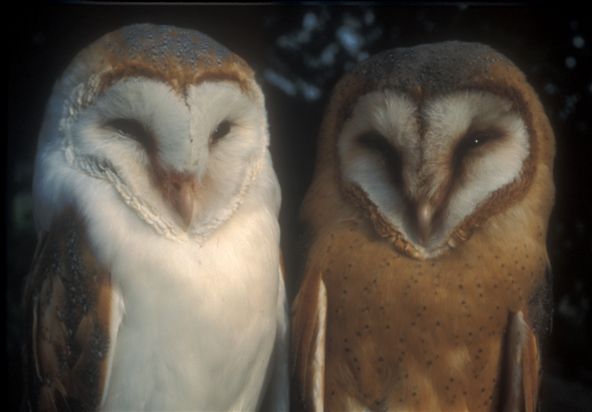
A pair of barn owls, showing a bit of sexual dimorphism, male on the left and female on the right (User: Hebi, 2009)

I’ve said earlier that barn owls hunt small mammals, what techniques do they use against such nimble prey? Aside from choosing home-ranges which are based on the abundance of prey items, an environment with species-rich small-mammal communities (Askew et al., 2007). T.alba can target prey entirely acoustically, letting them find and hunt in complete darkness (Usherwood et al., 2014). One of the ways in which T.alba hunts is by the leap and strike method (Usherwood et al., 2014) which you may have seen in the linked video of my burrowing owl post, where the owl leaps up then have a short flight, before striking the prey (Usherwood et al., 2014). The combination of a well-developed learned and genetic auditory and visual perceptive systems and morphological traits makes the barn owl a truly efficient predator in the dark (Bergan et al., 2005, Harmening and Wagner, 2011, Langemann et al., 2005, Usherwood et al., 2014).

To finish off I shall show you guys another wonderful video ^_____,^


ASKEW, N. P., SEARLE, J. B. & MOORE, N. P. 2007. Prey selection in a Barn Owl Tyto alba. Bird Study, 54, 130-132.
BACHMANN, T., WAGNER, H. & TROPEA, C. 2012. Inner vane fringes of barn owl feathers reconsidered: morphometric data and functional aspects. Journal of Anatomy, 221, 1-8.
BERGAN, J. F., RO, P., RO, D. & KNUDSEN, E. I. 2005. Hunting Increases Adaptive Auditory Map Plasticity in Adult Barn Owls. The Journal of Neuroscience, 25, 9816-9820.
HARMENING, W. & WAGNER, H. 2011. From optics to attention: visual perception in barn owls. Journal of Comparative Physiology A, 197, 1031-1042.
LANGEMANN, U., ZOKOLL, M. A. & KLUMP, G. M. 2005. Analysis of spectral shape in the barn owl auditory system. Journal of Comparative Physiology A, 191, 889-901.
USER: HEBI 2009. Barn Owl. Wikepedia.

USHERWOOD, J. R., SPARKES, E. L. & WELLER, R. 2014. Leap and strike kinetics of an acoustically ‘hunting’ barn owl (Tyto alba). The Journal of Experimental Biology, 217, 3002-3005.

Tuesday, May 19, 2015

Doing Well


Doing Well

Nankeen kestral.jpg
F.cenchroides at Wyvuri Station, North Queensland (Bendon, 2013).
                The Australian kestrel, Falco cenchroides also called the nankeen kestrel is a species of kestrel that’s endemic to Australia and the lower part of New Guinea (Ferguson-Lees and Christie, 2001). With a population estimated at up to and quite possibly beyond 750,000 breeding pairs, which means about 1.5 million mature adults (Ferguson-Lees and Christie, 2001), it is one of two most abundant diurnal raptor in Australia (the other being Falco berigora, the brown falcon) and the population could well be increasing (Ferguson-Lees and Christie, 2001). The success of the Australian kestrel has a bit to do with human activity, unlike most species which are negatively impacted by current levels of urbanisation and human expansion (Chace and Walsh, 2006) F.cenchroides thrive quite well with the clearing of forests, which opens up feeding ground for them and adapts well to habitats affected and altered by humans including architecture (Ferguson-Lees and Christie, 2001).


                Raptors such as kestrels often have large home ranges extending beyond urban areas which means their ecological needs can be met by resources from both outside and within urban areas (Chace and Walsh, 2006). Urban development usually means an increase in biomass but decrease in biodiversity, the decrease in prey choice is an issue to many predators, however F.cenchroides’s diverse diet of small birds, mammals, insects, reptiles and unusually for raptors, spiders allow them to succeed (Ferguson-Lees and Christie, 2001). The majority of prey taken are small birds such as Common Starlings (Sturnus vulgaris) when they are numerous (Ferguson-Lees and Christie, 2001) which can be found in many urban centres.
                But we have to remember, that some species are doing well from human impacts but many more are not (Chace and Walsh, 2006). But looking at these urban dwellers we can get a picture of what a more urbanised future can look like around the world.


BENDON, J. 2013. Nankeen Kestrel (Falco cenchroides) at Wyvuri Station, North Queensland. Flickr.
CHACE, J. F. & WALSH, J. J. 2006. Urban effects on native avifauna: a review. Landscape and Urban Planning, 74, 46-69.
FERGUSON-LEES, J. & CHRISTIE, D. A. 2001. Raptors of the world, Houghton Mifflin Harcourt.

Sunday, May 10, 2015

Bone Breaker

A dassie (Procavia capensis) in Hermanus, South Africa,
a prey item of G.barbatus 
(User: Amada44, 2009).
This time we’re going to go and look at a raptor with a rather unique diet, Gypaetus barbatus otherwise known as the lammergeier or bearded vulture. The species has somewhat of a patchy distribution from Western Asia all the way to East Africa and even some in South Africa (Ferguson-Lees and Christie, 2001). So, you might be wondering about the title of this post, although you could say that yeah, falcons break the necks of their prey with their beaks or that eagles and hawks sever the spinal cord of their prey with their talons, but none of them EAT the bones! That’s right, G.barbatus aside from carrion as part of their diet, they also eat bones as a large part of their diet as well as tortoises (Ferguson-Lees and Christie, 2001). The way G.barbatus goes about eating these bones is something seen across several bird species as a way to break seeds or kill prey, if the bones are small enough the lammergeier will swallow it whole, however if the bones are large then what they do is take it up high (up to 150m) and drop it on hard rocks to break it (Ferguson-Lees and Christie, 2001). They may also smash the bones on the ground while holding onto it in the beak (Ferguson-Lees and Christie, 2001). What do they do with the tortoises? I hear you ask, well tortoise shells are quite hard and they treat them like bones, meaning they’ll take them up high and drop them onto rocks to kill them, they also do this with the super cute rock hyraxes, also known as dassies (Procavia capensis) (Ferguson-Lees and Christie, 2001). Aside from this, in my opinion the most amazing thing is that lammergeiers will use the bone-dropping sites known as ossuaries for decades, probably centuries and large mammals have been known to be attacked by beating wings until they fall off cliffs and die (Ferguson-Lees and Christie, 2001).
A G.barbatus in Gran Paradiso National Park (User: Aangelo, 2014)

Unfortunately though these birds’ populations have declined in the last 2 centuries especially in Europe (Godoy et al., 2004). The species is listed as near threatened by IUCN red list but was close to extinction in Europe and is locally extinct in many countries (Godoy et al., 2004, BirdLife International, 2014). Genetically there are two distinct populations by analysing mitochondrial DNA, a European lineage and an African Lineage, due to the bottlenecking of the population in Europe the population have lost tremendous genetic diversity making it important to protect the remaining European populations (Godoy et al., 2004).


BIRDLIFE INTERNATIONAL. 2014. Gypaetus barbatus [Online]. The IUCN Red List of Threatened Species. Version 2014.3: The IUCN Red List of Threatened Species. Available: www.iucnredlist.org [Accessed 10 May 2015.
FERGUSON-LEES, J. & CHRISTIE, D. A. 2001. Raptors of the world, Houghton Mifflin Harcourt.
GODOY, J. A., NEGRO, J. J., HIRALDO, F. & DONÁZAR, J. A. 2004. Phylogeography, genetic structure and diversity in the endangered bearded vulture (Gypaetus barbatus, L.) as revealed by mitochondrial DNA. Molecular Ecology, 13, 371-390.
USER: AANGELO 2014. Gypaetus Barbatus.
USER: AMADA44 2009. Rock Dassie 005.