Tyto alba commonly
known as the barn owl. These guys, like most owls, are nocturnal and mainly
hunts small mammals (Askew et al., 2007). T.alba
has a remarkable trait to fly almost silently, this is done by a combination of
morphological adaptations in wing shape and their feathers (Bachmann et al., 2012). They have been reported to
have specialised plumage to control air-flow during flight (Bachmann et al., 2012). The remiges which makes up
for most of the area of the wing is highly responsible for the aerodynamic
performance of the bird (Bachmann et al., 2012). Fringes in feathers were
also found within the wing (usually only seen at the edges) which have been
found to suggest the function of merging of neighbouring feather vanes during
flight, which creates a smooth wing surface without sharp edges, further
reducing noise (Bachmann et al., 2012).
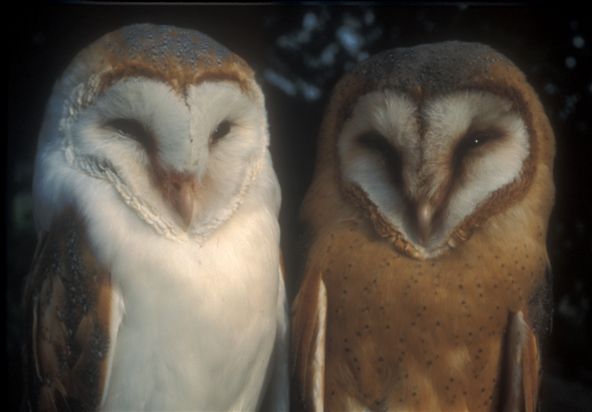 |
| A pair of barn owls, showing a bit of sexual dimorphism, male on the left and female on the right (User: Hebi, 2009) |
I’ve said earlier that barn owls hunt small mammals, what
techniques do they use against such nimble prey? Aside from choosing home-ranges
which are based on the abundance of prey items, an environment with
species-rich small-mammal communities (Askew et al., 2007). T.alba
can target prey entirely acoustically, letting them find and hunt in complete
darkness (Usherwood et al., 2014). One of the ways in which T.alba hunts is by the leap and strike
method (Usherwood et al., 2014) which you may have seen in
the linked video of my burrowing owl post, where the owl leaps up then have a
short flight, before striking the prey (Usherwood et al., 2014). The combination of a well-developed
learned and genetic auditory and visual perceptive systems and morphological
traits makes the barn owl a truly efficient predator in the dark (Bergan et al., 2005, Harmening and Wagner, 2011, Langemann et al., 2005,
Usherwood et al., 2014).
To finish off I shall show you guys another wonderful video ^_____,^
ASKEW, N. P.,
SEARLE, J. B. & MOORE, N. P. 2007. Prey selection in a Barn Owl Tyto alba. Bird Study, 54, 130-132.
BACHMANN, T., WAGNER, H. & TROPEA, C. 2012. Inner vane fringes
of barn owl feathers reconsidered: morphometric data and functional aspects. Journal of Anatomy, 221, 1-8.
BERGAN, J. F., RO, P., RO, D. & KNUDSEN, E. I. 2005. Hunting
Increases Adaptive Auditory Map Plasticity in Adult Barn Owls. The Journal of Neuroscience, 25, 9816-9820.
HARMENING, W. & WAGNER, H. 2011. From optics to attention:
visual perception in barn owls. Journal
of Comparative Physiology A, 197,
1031-1042.
LANGEMANN, U., ZOKOLL, M. A. & KLUMP, G. M. 2005. Analysis of
spectral shape in the barn owl auditory system. Journal of Comparative Physiology A, 191, 889-901.
USER: HEBI 2009. Barn Owl. Wikepedia.
USHERWOOD, J. R., SPARKES, E. L. & WELLER, R. 2014. Leap and
strike kinetics of an acoustically ‘hunting’ barn owl (Tyto alba). The Journal of Experimental Biology, 217, 3002-3005.

No comments:
Post a Comment