Hi
there, welcome to Beak and Talon, where I'll be talking about morphological (physical
attributes like beaks, wings and crests) and some behavioural adaptations of
Birds of Prey, Raptors or whichever is to your liking. Maybe you’re wondering,
what is a bird of prey or raptor? Like those things in Jurassic park? Or do you
just have no clue? Well for those of you who fit in the latter category, I
think this is a good place to start.

Birds
of prey is a broad term referring to a variety of families of birds which are
carnivorous in nature. There are both diurnal and nocturnal species e.g.
falcons and owls. Owls have been around at least since the Paleocene more than 56mya
(Mayr, 2006) and other taxa (scientific
term regarding a taxonomical group ie. What scientists use to classify
different living things) such as the family Accipitridae (Hawks, eagles, old
world vultures etc.) have been around for at least 20 million years (Walker and Dyke, 2006). They usually have sharp hooked beaks, sharp talons and
generally have very good eyesight because of their similar roles in their
ecosystems. They vary greatly in size from the small black-thighed falconet
with a wingspan of only about 30cm (about the size of a sparrow to the massive Andean
condor which can have wingspans of just over 3m (Ferguson-Lees and Christie, 2001).
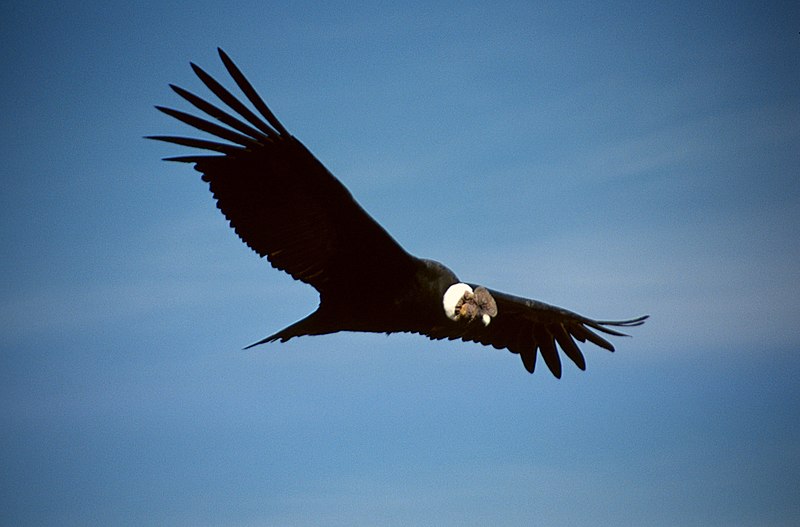 |
| Adult Andean Condor in flight. Source: www.wikipedia.org |
These
remarkable group of birds can be found all over the world from the deserts of
Africa and Australia to the rainforests in South East Asia and even the Arctic Circle (Ferguson-Lees
and Christie, 2001). Each group of birds has their own specialty and have procured different
evolutionary tactics when they hunt or forage for food. Despite the differences
between species, there are general similarities for different families, from
the scavenging vultures and condors to the striking falcons and vice gripping
eagles. These birds have all evolved to fulfill their specific niche; from
gliding to diving, tearing and gripping, ripping and striking, their wings,
talons and beaks are all suited to their needs and behaviours and that’s just
skimming the surface of what these wonderful creatures have to offer.
Come
back next week as we start to look at each of these birds more closely!
FERGUSON-LEES, J. & CHRISTIE, D. A.
2001. Raptors of the world, Houghton
Mifflin Harcourt.
MAYR, G.
2006. A new raptorial bird from the Middle Eocene of Messel, Germany. Historical Biology, 18, 99-102.
WALKER,
C. A. & DYKE, G. J. 2006. New records of fossil birds of prey from the
Miocene of Kenya. Historical Biology,
18, 95-98.

This comment has been removed by the author.
ReplyDeleteA very interesting topic! Will you be looking at the evolutionary history of the birds of prey too? I am very curious to know if Velociraptor had any involvement I am looking forward to learning more about these birds.
ReplyDeleteYeah, I will be, how specific they'll be (species, genus or family) i'm not too sure yet, but it will definitely be quite a "catch" get it, coz they catch their prey :P (my jokes are horrible)
Delete